
Hosting may seem simple at first, storage, bandwidth, uptime. But as a website grows, the risks grow with it. Complaints increase, policies become stricter, and one misunderstood report can suddenly put everything at risk.
In many hosting environments, providers react quickly to protect themselves. Accounts are suspended first, explanations come later. For website owners who depend on stability, this unpredictability becomes a serious concern.
Offshore hosting offers a different approach. By placing your website in a foreign jurisdiction, hosting decisions are governed by the laws of that country, not your local enforcement system. Complaints are typically reviewed through defined legal procedures instead of triggering automatic shutdowns.
To understand offshore hosting clearly, it is important to look beyond assumptions. The following sections explain how it works, why it exists, where it is commonly located, its legal status, and who it is truly designed for.
Table Of Content
What is Offshore Hosting?
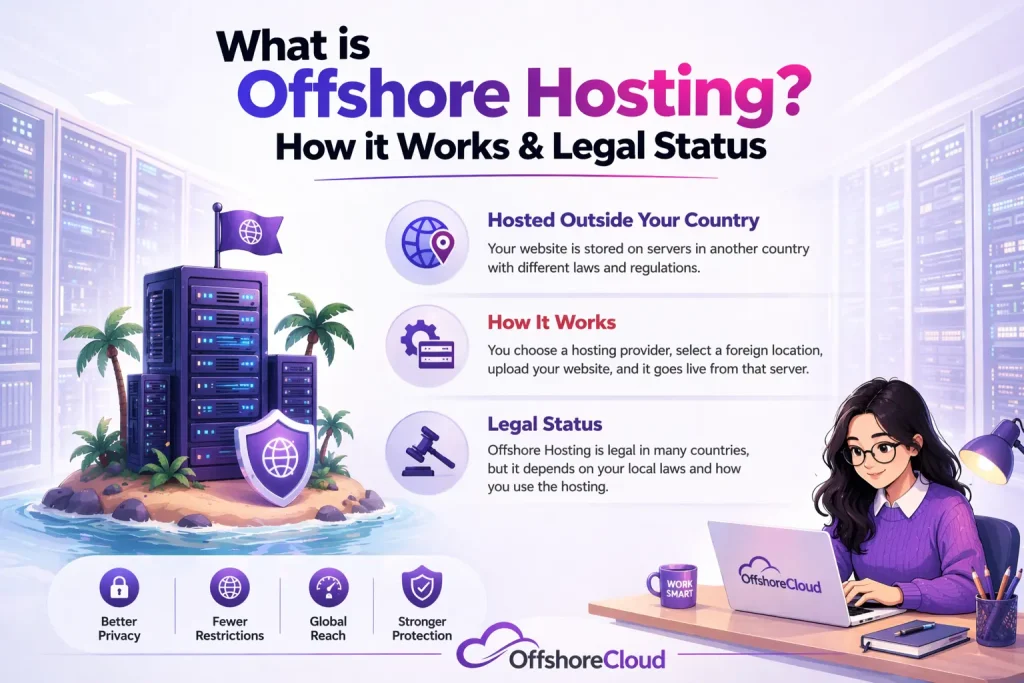
Offshore hosting refers to hosting a website, application, or server in a country different from the owner’s home country, typically outside the United States or local jurisdiction.
In offshore hosting:
- Website data is stored in data centers located in a foreign country
- The hosting provider operates under the local laws of that jurisdiction
- Legal and policy decisions follow the hosting country’s regulations, not the owner’s domestic laws
The purpose of offshore hosting is not to avoid laws, but to select a jurisdiction that applies clearer legal processes, balanced enforcement, and more predictable handling of complaints based on local regulations.
Why Offshore Hosting Exists
The internet may feel global, but content laws are enforced very differently from one country to another.
In some regions, hosting environments are extremely reactive. A single complaint, sometimes without verification, can lead to immediate account suspension. Providers often disable websites first and ask questions later, leaving site owners without clear explanations or warning.
In other jurisdictions, the approach is more measured. Complaints are reviewed carefully, proper legal documentation is required, and hosting providers avoid taking action unless local laws clearly demand it. Decisions are based on process, not pressure.
Offshore hosting exists because many website owners look for predictability and fairness, not loopholes.
They want:
- Protection from sudden, unexplained shutdowns
- Policy enforcement that follows defined procedures
- Stronger privacy standards
- Infrastructure that remains stable even during disputes or complaints
At its core, offshore hosting is about risk management and operational stability, not avoiding rules, but choosing an environment where rules are applied carefully and consistently.
How Offshore Hosting Works in Practice
From a technical perspective, offshore hosting functions the same way as any standard hosting service. There is no special setup or complicated process involved.
You choose a hosting plan, shared, VPS, or dedicated, upload your website or application, and visitors access it normally through the internet. Performance, uptime, and accessibility work just as they would on traditional hosting.
The real difference becomes visible only when a problem arises.
This could include:
- A copyright related complaint
- A policy or abuse report
- A legal request from an external party
In such situations, offshore hosting providers typically do not react automatically. Instead of suspending accounts immediately, they first evaluate the issue under their local legal framework.
Most providers:
- Review complaints based on local laws and regulations
- Require valid legal documentation before taking action
- Avoid instant shutdowns unless a clear legal violation is established
This measured approach helps ensure that websites are not disrupted unnecessarily and that actions are taken based on law and process, not assumption or pressure.
What Offshore Hosting is NOT
This is the area where offshore hosting is most commonly misunderstood.
Offshore hosting does not mean hosting illegal content, avoiding law enforcement, operating without rules, or receiving guaranteed anonymity. These assumptions often come from misinformation rather than real world hosting practices.
Most offshore hosting providers maintain strict policies and clearly prohibit serious violations, including:
- Child exploitation material
- Malware, hacking tools, or botnet activity
- Scams, phishing attempts, or fraudulent operations
- Terrorism related content
Choosing offshore hosting does not remove legal responsibility. It only changes the jurisdiction under which hosting decisions are reviewed and enforced.
Criminal activity remains illegal regardless of where a server is located, and offshore hosting does not provide protection from lawful consequences.
Types of Offshore Hosting
Offshore hosting is available in different formats, allowing website owners to choose a setup that matches their project size, traffic level, and operational needs. The core difference between these options lies in resource allocation, control, and scalability.
Offshore Shared Hosting
Offshore shared hosting is the most affordable option and works similarly to standard shared hosting.
In this setup:
- Multiple websites share the same server resources
- Costs remain low due to shared infrastructure
- Management is handled mostly by the hosting provider
This option is best suited for small websites, blogs, landing pages, or personal projects that have low traffic and minimal technical requirements.
Offshore VPS Hosting
Offshore VPS hosting provides a balance between cost and performance.
With a VPS:
- Server resources are divided into isolated virtual environments
- Each user receives dedicated CPU, RAM, and storage allocations
- Greater control and customization are available compared to shared hosting
This type of offshore hosting is commonly used by growing websites, applications, and businesses that need better reliability, scalability, and administrative control without the cost of a full server.
Offshore Dedicated Servers
Offshore dedicated servers offer the highest level of performance and isolation.
In this model:
- A full physical server is assigned to a single client
- All hardware resources are exclusively available
- Maximum control over configuration, security, and software is possible
Dedicated offshore servers are typically chosen for high traffic websites, large platforms, data intensive applications, or projects that require strong isolation and operational stability.
Top Offshore Hosting Locations
Offshore hosting is commonly offered in countries that have reliable infrastructure and legally independent hosting environments. These jurisdictions usually require local legal procedures before taking action, instead of automatically enforcing foreign complaints.
Common offshore hosting countries include:
- Netherlands
- Romania
- Moldova
- Luxembourg
- Switzerland
- Hong Kong
- Bulgaria
- Czech Republic
- Iceland
- Malaysia
- Singapore
- Panama
In these locations, hosting providers generally follow local laws and established legal procedures before acting on complaints or legal requests.
This approach helps prevent sudden shutdowns based solely on external pressure and is a key reason these countries are preferred for offshore hosting.
Why Location Matters in Offshore Hosting
The importance of location in offshore hosting comes down to how legal authority is applied.
Most offshore hosting jurisdictions do not operate under automatic foreign enforcement models. Hosting providers are not required to act immediately on complaints that originate outside their own legal system.
Instead, providers typically:
- Follow local legal procedures and regulations
- Require valid court orders or legally recognized documentation
- Avoid unnecessary or premature shutdowns
This legal independence is what gives offshore hosting its value. It allows website owners to choose a jurisdiction where issues are handled through defined legal processes rather than immediate reaction.
Offshore hosting is not about exploiting loopholes. It is about jurisdictional choice and predictable enforcement based on local law.
Offshore Hosting vs Traditional Hosting
The difference between offshore hosting and traditional hosting is not related to speed or performance. The real distinction lies in how issues, complaints, and legal situations are handled.
| Aspect | Traditional Hosting | Offshore Hosting |
| Jurisdiction | Website owner’s home country | Foreign country |
| Complaint handling | Often immediate action | Process based review |
| Privacy | Moderate protection | Often stronger protections |
| Policy enforcement | Strict and reactive | More flexible and procedural |
| Stability under pressure | Lower during disputes | Higher during complaints |
Traditional hosting providers often prioritize rapid response, which can result in sudden suspensions even before proper review. Offshore hosting providers, on the other hand, usually rely on structured legal processes and local regulations before taking action.
The key difference is not performance or infrastructure. It is the way problems are evaluated, verified, and resolved.
Is Offshore Hosting Legal?
Yes, offshore hosting is legal when it is used responsibly and within the boundaries of the law.
It is legal because businesses and individuals are allowed to choose where their data and servers are hosted. Using hosting services in another country does not violate any general laws by itself.
Offshore hosting providers operate under their own local legal systems and are required to comply with the regulations of the country where their infrastructure is located.
Legal issues arise only when a user hosts criminal content. Activities such as fraud, malware distribution, or exploitation are illegal in every jurisdiction and are not protected by offshore hosting.
In short, offshore hosting is a lawful hosting option. Legality depends on how the service is used, not on the location of the server.
Why Website Owners Choose Offshore Hosting
People usually switch to offshore hosting after repeated issues with standard hosting.
Common reasons include:
- Content being reported unfairly
- Sudden account suspensions
- Overly strict hosting rules
- Privacy concerns
- Need for hosting stability
Offshore hosting offers predictability. Issues are handled through legal processes, not panic driven reactions.
Who Should Consider Offshore Hosting?
Offshore hosting is a suitable option for website owners and businesses that operate within the law but face higher operational risk due to the nature of their content or audience.
It may be a good fit if:
- Your content is legal but frequently flagged or misunderstood
- Your website receives repeated complaints despite compliance
- Your project cannot tolerate sudden downtime or interruptions
- You place high importance on privacy and administrative control
- You prefer hosting environments that follow due legal processes
Offshore hosting helps in maintaining stability by ensuring that issues are reviewed carefully rather than acted on immediately.
Who Should Avoid Offshore Hosting?
Offshore hosting is not appropriate for those who intend to misuse the service.
You should avoid offshore hosting if:
- You plan to host illegal or criminal material
- You are attempting to evade lawful investigation or enforcement
- Your activities violate local or international laws
Offshore hosting does not remove legal responsibility. Responsible and lawful use is essential in every jurisdiction.
FAQs
1. Is offshore hosting legal to use?
Yes, offshore hosting is legal when used for lawful purposes. Website owners are allowed to host their data in another country. Offshore hosting providers follow the laws of the country where their servers are located. Legal problems arise only if illegal or criminal content is hosted.
2. Does offshore hosting protect a website from complaints?
Offshore hosting does not block complaints. It ensures that complaints are reviewed under local laws and proper legal procedures. Valid complaints can still result in action, but unfair or unverified reports usually do not lead to instant shutdowns.
3. Does offshore hosting affect website speed or performance?
No, offshore hosting does not automatically affect website speed. Performance depends on server quality, network connectivity, and optimization. Many offshore locations use modern data centers and provide stable and reliable performance similar to traditional hosting.
4. Do I need technical skills to use offshore hosting?
No special technical skills are required. Offshore hosting works the same way as regular hosting. You can use standard tools like control panels, WordPress, and FTP to manage your website easily.
Conclusion
Offshore hosting exists because digital businesses operate globally, while laws remain local. As websites grow, stability, privacy, and predictable enforcement become just as important as speed or storage. Sudden suspensions and reactive policies can disrupt legitimate projects, even when no clear violation exists.
By choosing offshore hosting, website owners select a jurisdiction where complaints are handled under structured legal procedures rather than automatic reactions. It does not remove responsibility or override the law. It simply ensures that actions are taken based on proper legal authority.
For projects that require continuity, balanced enforcement, and stronger privacy standards, offshore hosting offers a practical and lawful solution. The key is responsible use within legal boundaries, because stability comes from process, not from avoiding accountability.
